

The second time the girl with the falcon and the Latin tutor meet, he’s embarrassed.
The first time they met, he mistook the girl – Agnes (Jessie Buckley) – for one of the serving girls, and, in quite a forward move, kissed her before she ran off. He has since learned that she’s the eldest daughter of the family he’s been working for and has come, chagrined, to apologize. But he doesn’t necessarily regret his actions, just his mistake. He’s fascinated by Agnes. In fact, she renders him a bit dumb. “I find speaking to people sometimes difficult,” he tells her.
Agnes finds his inability to speak a little ironic (and has no problem calling it out). And it is a bit ironic, given that the Latin tutor is William Shakespeare (Paul Mescal). Not yet known for the works that will make him the most famous playwright in history, but a known intellectual and wordsmith around their small town no less. As his stuttering dies down, Will decides to tell Agnes the story of Orpheus and Eurydice. He transforms, then, from an awkward boy to a man alive with the power of the poetry pouring out of him.
This will become a theme in Agnes (more commonly known as Anne Hathaway) and Will’s relationship — her emotions coming easy, raw, and unfiltered, while he finds it necessary to process his through art. “Hamnet,” Chloé Zhao’s adaptation of Maggie O’Farrell’s 2020 novel of the same name, dramatizes that dynamic in connection with the death of the couple’s 11-year-old son Hamnet (Jacobi Jupe), which in turn inspires perhaps Shakespeare’s most famous play, “Hamlet.” (The film begins with by telling us that those two names would have been interchangeable at the time)
While a bit clunky in its narrative setup, “Hamnet” slowly nestles into your heart, evolving into a beautifully considered meditation on art and legacy, but not necessarily in the way you expect a movie that’s, at least in part, about William Shakespeare to be. Although “Hamnet” is unmistakably about grief, it feels trite to pin its considerations down to just the process of dealing with unimaginable loss. Instead, “Hamnet” is also about the pain and joy of creation, both in parenthood and art. It’s about two people in a constant dance with each other and the world, reckoning with their pasts in an attempt to build something stronger together.
With “Hamnet,” Zhao seems deeply invested in what the novel has to say about legacy. Not from a grand perspective, but rather how we reckon with what it is our parents have left us. Agnes has a strong desire to stay connected to the physical world around her — a trait she picked up from her late mother, and a desire completely divorced from that of her husband, who falls into his imagination to escape his abusive, overbearing father (and even that isn’t far enough away). Her fingernails are dirty, her hair a tangled mess. She chooses to have her firstborn daughter, Susanna (Bodhi Rae Breathnach) in the woods, the wind wailing, moaning, and screaming with her.
These are all superficial markers of a woman connected to the natural world, but for this character, it’s less about the forest itself and more about reaching for some spiritual connection to the mother who loved the woods well, and who left her too early. The second time Agnes gives birth to her twins, Hamnet and Judith (Olivia Lynes), she’s forced to stay inside. She wails for her mother, for the relative ease of this process when she could feel her presence in the trees.
This second birthing scene also represents one of the core ideas of “Hamnet,” which is creation as communion. It might be a very singular thing, to give birth — or, to write a play — but the effect is communal. Agnes’ mother-in-law Mary (Emily Watson) is firmly in the anti-Agnes camp when they first meet, but it’s here where an understanding finally blooms between the two women. In Agnes’ pain and grief, Mary comforts her by telling her that her husband was born in this very room. Took his first breaths over by the window in the corner. She is communicating to Agnes that she and her children belong here as much as they belong in the woods, soothing a fear and creating a new safe haven in the process.
Will and Agnes are often creating together, but even the things they ostensibly create separately — he misses the birth of the twins, his imagination forever taking him away to London, and later, she is unaware that he is writing a play that shares a name with their deceased son — are forged with both of them in mind. There’s a reason the backdrop for “Hamlet” looks exactly like Agnes’ woods. She is up there as much as he is.
When grief strikes though, it’s difficult to find that sense of togetherness again. Zhao films many of the scenes in “Hamnet” like a play, a static camera that lets the actors move about the space. The effect can be strangely alienating at times, but when it works it captures the tragedy of change. There is a particular shot of the twins’ room that repeats throughout the film — the shot is the same, but the context is different, a simple way for Zhao to show us the sadness of a space, despite its physical characteristics barely changing,
In that sadness, it becomes painful to create. It’s agonizing to put so much of yourself into something, dedicate your life to nurturing and protecting it, and have it be gone in an instant. There’s a tension between Buckley and Mescal’s performances throughout the film, but their reactions to Hamnet’s death draw out those stark differences. Buckley is so free with her movements, whether it be an upward quirk of her mouth or the guttural scream she releases upon the death of her son. Mescal feels more self-conscious in a very male, artistic sort of way. He lets out a small, “That’s my boy” when he looks upon Hamnet’s body, the tears only fully coming when he’s alone.
Agnes has no issue telling him how little she thinks of how he handles his grief. She derides his decision to retreat back into that place in his head, to go back to his stories instead of confronting this head on the way she is forced to. There is an argument to be made that he’s running away. Even with the film’s eventual end, with Will confronting Hamnet’s death through his work, he still left a family behind to do so. He retreated into himself, leaving them to go it alone. The movie never really contends with that damage, rushing through Agnes’ hurt over finding out about the play, whereas the novel wraps you up in her boiling rage.
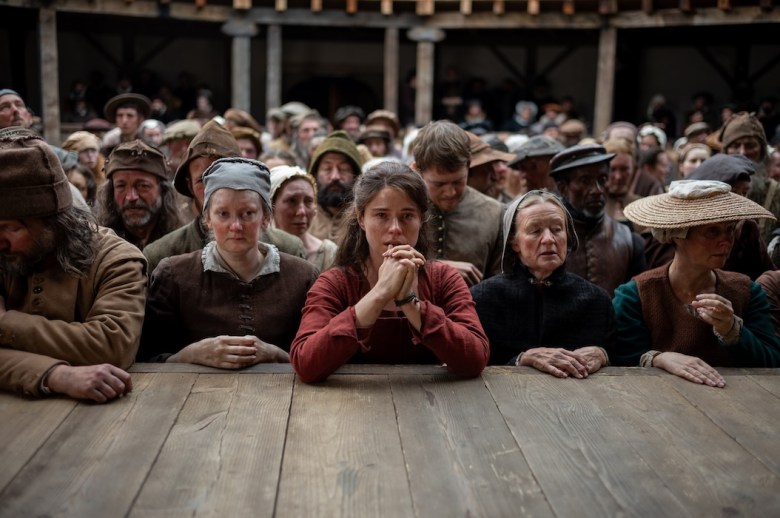
And yet, in his retreat, Will finds another act of creation, not to recover what he has lost, but to share in that grief, and joy, and wonder with his wife and the world in the way he knows how. “Hamlet,” thankfully, does not represent a one-to-one of the tragedies of “Hamnet.” So, as the rest of the world feels the pain of a young man avenging his father, feels Agnes and Will’s pain siphoned through a different lens, Agnes is able to finally hear her husband’s grief as best he can express it, to see her son’s desire to be one of his father’s players borne out in the young actor at the show’s helm (Noah Jupe – the real life brother of Jacobi Jupe). It’s just as it was in the beginning, when she was able to hear Will’s love and affection for her through the lens of the story of Orpheus and Eurydice.
Through “Hamlet,” one of the aims of art is achieved: Will, Agnes, and Hamnet’s story becomes something universally understood, but it is still theirs — something forged out of their own pain, and pasts, and joys. Shared, but completely their own.