

When my mother moved into nursing care many years ago, I became the custodian of our family history: dozens of large envelopes, bulging albums, and even a small “horse-hair” trunk. They contained handwritten deeds, certificates, wills, and other memorabilia from the late 1700s to the 1940s. In this unorganized jumble of births, deaths, news stories, old photos, and family trees, I found an amazing woman—Helen Cowles Whitehead, my grandmother.
Born in New York City in 1880 and educated there in physical education and social work, my grandmother moved to Norfolk, Virginia, as the bride of a physician in 1909, and got involved in her community. Today, we would call her an activist. By the time she died in 1948, a few years before I was born, she had helped improve public welfare programs throughout the city and, in 1913, established Norfolk’s public playground program in five city parks. As a longtime advocate for rivers, parks, and other natural areas, I like to think that my DNA mix may contain some of her genes.
Beloved Green Spaces
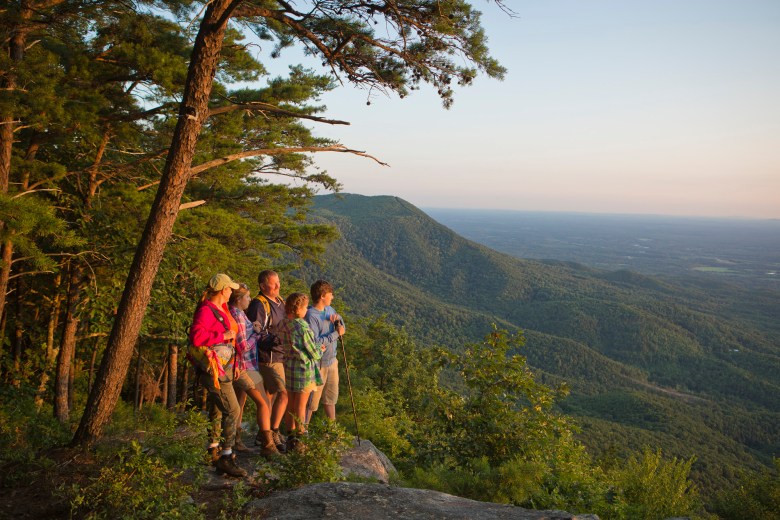
Georgians love parks. Whether located in cities or remote areas, they are places where people can go for physical and mental well-being: a way to manage stress in an increasingly stressful world. In 1634, the oldest public park in America was created as the Boston Common. Two and a half centuries later, the first national park was established as Yellowstone National Park (1872), and the first state park, in 1885, at Niagara Falls State Park in New York. (The preservation of California’s Yosemite Valley in 1864 by President Abraham Lincoln was an early example of land being set aside for public use, instead of homesteads.)
Early in the twentieth century, social reform advocates initiated the playground movement in parks to promote health and happiness, public safety on crowded streets, and reduce crime. The first municipal playground was installed in New York City. Child and family welfare advocates, including my grandmother, saw the immense benefits offered by this innovative, largely government-funded concept. People of all income levels and abilities could find community, new skills, and solace in nature. Public parks became a firmly established government responsibility nationwide.
Public green spaces are also essential to democracy. They function as social “infrastructure,” providing shared, accessible places in nature that can foster a sense of community. The question of whether public parks should be free or require an entrance fee involves balancing social equity (fairness to all) and public health benefits against the need for maintenance funding.
Today, most of us are living with high levels of uncertainty in our personal lives and in our country. Affordability is a serious concern. A recent poll found that a majority of Americans say they’re spending more on groceries and utility bills than a year ago. At such a time—with a budget and reserve surplus of more than $14 billion—why did the state of Georgia decide to double the cost for its citizens to find exercise and some respite in a public park?
Entrance Fees
Georgia has nearly 50 state parks and 15 historic sites that attract millions of visitors every year. Maintenance of these sites costs about $109 million annually—half of which is offset by various user fees, including $5 for a daily parking pass, or $50 for an annual pass. The remainder is supported by state and some federal appropriations. At least four southern states do not charge any fee for visitors to their public parks.
It’s no surprise that park maintenance and repair costs are rising—just like everything else. The Georgia Board of Natural Resources (Board), which oversees state park management, commissioned a performance audit that recently recommended dozens of ways in which Georgia’s parks can generate additional revenue from their millions of annual visitors.
Unanimously, the Board voted in favor of one recommendation: to increase parking pass fees. Daily passes will be doubled to $10 and annual passes increased to $70 beginning in January. A variety of other services, from golf fees to cottage and campsite rentals, were also suggested as possible revenue generators; the state says it has “no timetable” for implementing those increases now.
Tone-Deaf and Callous
It’s true that people often value an opportunity more if they pay some amount for it. That said, I believe it’s completely tone-deaf and downright callous for the Board of wealthy political appointees to make it more expensive for families—and veterans and senior citizens—to enjoy Georgia’s public parks, especially as personal and family expenses are dramatically increasing.
The auditors found that the $10 daily pass could increase annual revenue by $3.7 million and that, hypothetically, $15.8 million might be raised if 10 percent of Georgia’s registered vehicles paid for the discounted park pass.
At the hearing before the Board vote, Mark Woodall, legislative chair for the Sierra Club Georgia Chapter, summarized the concerns of those opposed to the fee increase: “The state parks of Georgia should be for all the people of Georgia, regardless of income. With over $14 billion in reserve, it would be outrageous for the state parks to increase fees. In these difficult times, we ought to be encouraging people to get outdoors, not making it harder.”
Members of the Georgia Board of Natural Resources are appointed by the governor. All 19 existing members were appointed by Republican governors over the past two decades. Not a single one has experience or training as an environmental scientist, engineer, biologist, environmental educator, natural resource manager, or conservationist. The 2026 gubernatorial election will take place in less than a year. Voting matters!