

Sabine Taasa had four thriving and healthy sons on Oct. 6, 2023. When Hamas militants attacked her home and her neighbors’ homes in the early morning of Oct. 7, 2023, they killed Taasa’s husband as witnessed by two of her young children. Her oldest son, Or, was murdered at a nearby beach where he intended to go fishing.
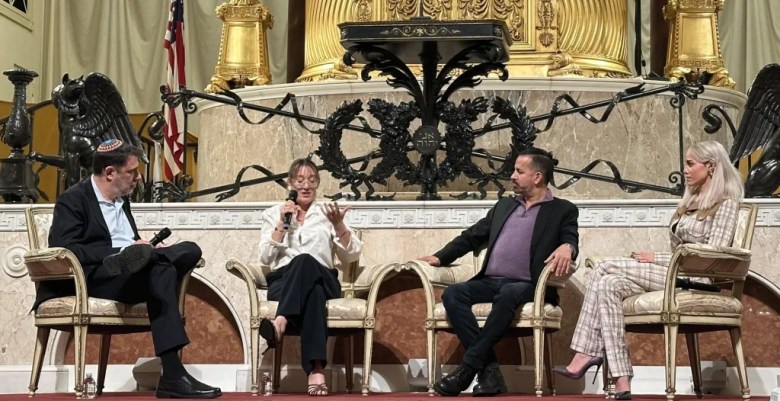
Taasa, a French-Israeli, spoke at The Temple in Midtown on Wednesday, Nov. 19, at a screening of “One Day in October.” The seven-part drama series, which is now streaming on HBO Max, is the first about the attack, and features Taasa’s journey in Episode 4.
As the audience inside The Temple’s sanctuary sat silent, still, and shocked, Taasa’s story was depicted on screen: a mother is awakened in Netiv HaAsara by grenade explosions, gunshots, screaming, and chaos. She tries to collect her children before Hamas can get to them. In one scene, Taasa, played by Israeli actress Yael Abecassis, leaves her safe room and opens a bulletproof door to find her young children standing outside, covered in blood and wounds. Koren and Shai Taasa had run from gunmen who moved on after their father, 46-year-old Gil Taasa, jumped on an open grenade to save their lives.
After the screening, Rabbi Peter Berg of The Temple led a discussion between Taasa, co-creator Daniel Finkelman, and producer Chaya Amor.
Taasa explained her drive to share her story. She said she was “in a bad situation” when co-creator Oded Davidoff approached her about the series. Each of her sons is suffering – from loss of eyesight, shrapnel injuries, PTSD, and a loss of faith in humanity.
“He said to me, ‘Please, I believe in your story. I want to show it to the world. I have all the tools … And I said to him, ‘I don’t know if it’s the right moment. I don’t know if I can do it. I don’t know if I will be able to tell my story because I am still in shock,'” Taasa recalled. “But I must tell people what happened on Oct. 7. This must be in the history books.”
Berg asked Taasa what she wants people to do after watching “One Day in October.” The answer was simple: “Stop being naive.”
“I want the world to open their eyes, and understand and see that the real situation in Israel is that we are, all of us, living together,” Taasa said. “In Haifa, Tel Aviv, Jerusalem, Be’er Sheva, Ashkelon, Ashdod. You will see Muslims, Christians, and Jewish people living together.”
Taasa said every day she wakes up and thinks about whether she can continue “fighting the good fight.” During the screening, she leaned toward Berg and said she could feel her son and husband in the room. “I cannot explain what I felt,” she said later on stage.
Each speaker relayed stories about antisemitism in the post-Oct. 7 world. Taasa ended a tense exchange with a television reporter. Amor was asked for proof that hostages were taken and that children were attacked.
“It came to that point where [film executives] were like, ‘Okay, you know you need to get permission for certain kinds of footages. So did you get permission from Hamas to use their footage?” Amor said.
The biggest vaccine against hate is “shared, emotional, visual memory,” Finkelman said.
“If there’s one universal common denominator between all races, religions, even with people living in Ramah, Singapore, or Tel Aviv? It’s entertainment. Everyone sits down, takes their remote, and watches the same content more or less.”