

2023’s “Bonus Track,” Julia Jackman’s directorial debut, is a teen romance rooted in the types of romantic movie tropes we’re all familiar with. But if “Bonus Track” is a little tropey, it’s also undeniably sweet, forefronting a queer relationship and handling that tenuous connection with care.
Jackman’s latest film, “100 Nights of Hero,” also features a queer romance, but in an environment far removed from the familiar halls of high school. Based on the graphic novel “The One Hundred Nights of Hero” by Isabel Greenberg, the film takes place in a historical-adjacent world that feels just a tick or two off from our own. The costumes and the production design are outlandish and fantastical. The evil machinations of the patriarchy feel, unfortunately, all too recognizable.
The recently married Cherry (Maika Monroe) has one job: to have children. That’s a little difficult, though, when her husband Jerome (Amir El-Masry) refuses to touch her, preferring to carouse around with his friends. One day, Jerome announces he is leaving for 100 nights, and Cherry is left to fend for herself with only her beloved maid Hero (Emma Corin) and the seductively untrustworthy Manfred (Nicholas Galitzine) for company. Unbeknownst to Cherry, Jerome has made a bet with Manfred: If Manfred can manage to get Cherry into bed with him during one of those 100 nights, he gets Jerome’s castle – and everything in it.
When Jackman originally read Greenberg’s novel, she was struck by the many multitudes the story contained. She found it as playful as it was angry, and as familiar as it was distant. Its absurdity and humor kept her immersed in the world Greenberg created, despite its darkness.
“I was really struck by the fact that it felt quite relevant to our world, but I didn’t realize how much I’d been craving something that also felt like it was transporting you away from the world,” she said.
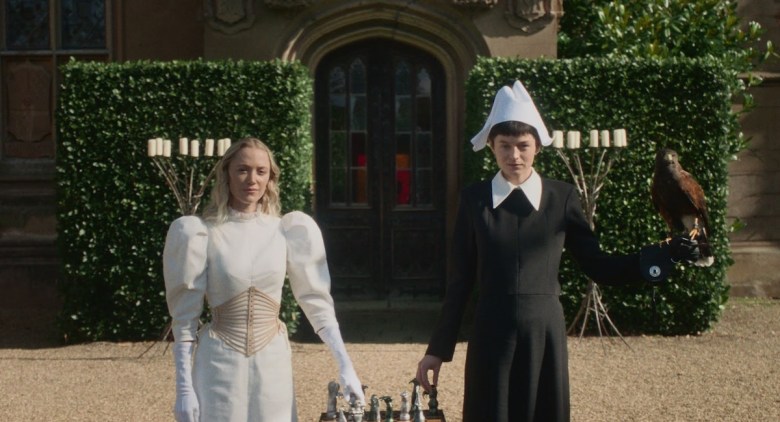
And transport you, it does. One of the calling cards for “100 Nights of Hero” is its production design and costuming (led by Sofia Sacomani and Susie Coulthard, respectively). It’s got the feel of a period piece, but with more elaborate flair – abstract rather than rooted in any sort of historical era. The costumes and the hats, especially (which Jackman said come directly from the graphic novel), feel representative of every character’s role. For Cherry in particular, it’s almost as if she shifts slightly depending on which hat she dons that day.
“[The hats] felt so much a part of the roles that people were expected to play,” Jackman said. “There was something so camp and theatrical about these hats. They were a real gateway for me into some flamboyant silliness in the costumes, rather than traditional.”
Known for horror films like “Longlegs” and “It Follows,” Cherry is an interesting role for Monroe to take on. But Jackman wanted her for exactly that reason. While “100 Nights of Hero” is billed as a fantasy romance, for Cherry, the particulars of the plot feel more like a thriller. If she doesn’t have a child, her life is over. If she gives into Manfred’s wiles, her life is over. If she embarks on a new romantic journey with Hero, her life is still over.
“She’s living in a very heightened version of what we experience as young women and teenagers,” Jackman said. “I remember very vividly feeling like I was in a minefield. Don’t be a tease, but don’t lead people on, but don’t be easy! There was this feeling that there was potential ruin around every corner.”
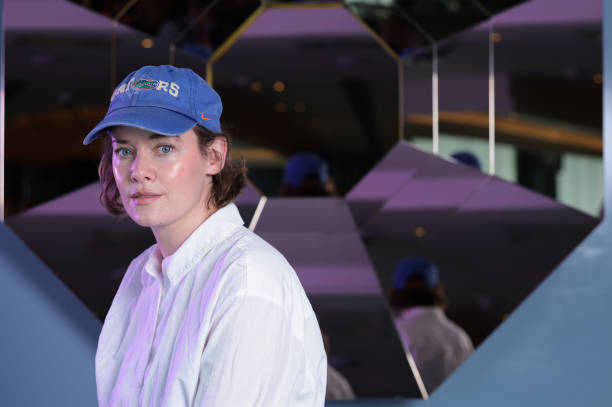
Jackman believed that Monroe would be able to also lend humanity to a woman in Cherry’s impossible situation, playing the horror of it, but infusing the character with a sense of humor and warmth at the same time. That sense of calm comes out in Monroe’s performance mainly when Cherry is around Hero. Despite all of Cherry’s apparent naivety, she is aware of the delicate nature of her situation. But when Cherry and Hero are alone together, the tension leaks from Cherry’s features, as if she can finally be herself.
“She’s not an idiot,” Jackman said. “She is a smart woman who just hasn’t been encouraged to be in touch with herself at all.”
One of the core themes of “100 Nights of Hero” lies in the literal power of storytelling. In a world where women must bear children, but are not taught to read or write, passing down stories to one another becomes a way of maintaining power. Those stories necessarily evolve as time passes on, molding to fit the world they now exist in.
That’s not so different from Jackman’s experience writing the script. The first draft was very true to Greenberg’s novel. But when Jackman revisited it later on, she had thought a little harder about what she believed the heart of the story was, and what core tenets she wanted to preserve while still recognizing that the story would be materializing in a different time and a different medium – a film in 2025 as opposed to a graphic novel in 2016.
“There’s an angry and sincere message at the end. In the graphic novel, it struck me that [Isabel] was funny and playful and absurd, and then it gives way to some sort of grief and anger that I think a lot of people feel, but especially, I think, women can identify with,” Jackman said. “We all have our own sources of disappointment and anger at the way that we are treated, or the boxes that we’re put in, as well as the joys.”
In addition to that tone and specific feminine anger, the love story was the most important thing. While “100 Nights of Hero” does feature an attraction between Cherry and Manfred, the real romance develops between Cherry and Hero.
“Seeing a love story like that, where two people are really an oasis for each other – I think especially in a queer love story, where you’re able to be a source of calm and relaxation, even when there’s the tension of desire and yearning, I really wanted to hold onto that,” Jackman said.
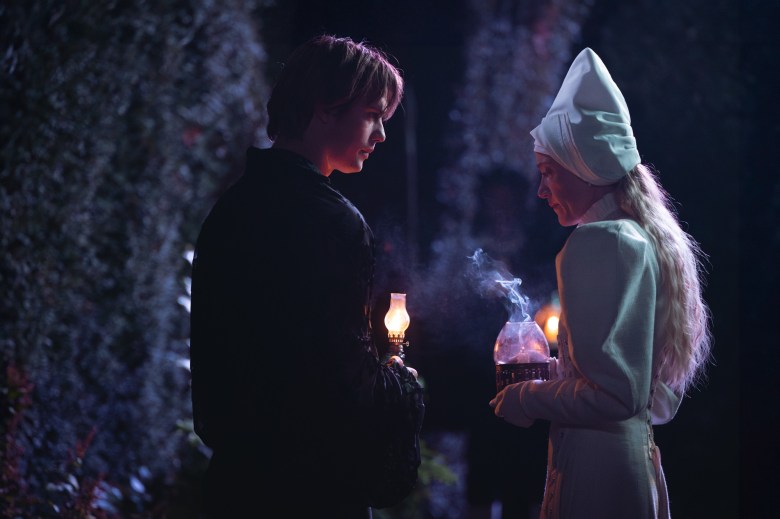
There’s a throughline of attraction in “100 Nights of Hero” that Jackman said is a little bit different from Greenberg’s novel. According to Jackman, Manfred is a little more “disgusting” in the book, which, admittedly, is a bit difficult to achieve when you cast Galitzine in the role. Jackman said that Galitzine was in the middle of training for his role as He-Man in the upcoming “Masters of the Universe” film around the time of shooting, which resulted in more changes.
“I incorporated it into Manfred’s character,” Jackman said. “I had him doing intense push-ups alone in his room, and getting that animal physicality and intensity to him.”
The fluidity of attraction is ever present in “100 Nights of Hero,” a little bit of flirting coming into the equation no matter which two people are involved in the conversation. Despite this being a very patriarchal world where relationships must be between cishet men and women, when Manfred and Jerome first make their bet over Cherry, you almost feel as though they’re about to seal it with a kiss.
Jackman said the inspiration for that quality came from observing the interactions between men in more seemingly macho cultures. She brought up bar culture in Italy as an example, full of very handsome men who are ostensibly womanizers, but seem to love each other more than the women they’re getting with.
“I think in repressed worlds, people are often very frustrated,” Jackman said. “And I think attraction is more fluid than people would like to admit sometimes.”